
Tata Motors Passenger Vehicles (TMPV) reported Q1FY27 results showing significant margin pressures at both Jaguar Land Rover (JLR) and its domestic operations, despite strong volume growth in the India business. Analysts expect these margin headwinds to persist, potentially offsetting gains from increased sales and new launches.

Tata Motors on Friday reported a 62.2 per cent decline in consolidated net profit to Rs 4,003 crore in the June quarter, impacted by volume decline across segments, drop in JLR profits due to US tariffs and high base effect due to gain from sale of discontinued operations. The auto major had posted a consolidated net profit of Rs 10,587 crore in the April-June quarter of the previous fiscal, Tata Motors Ltd (TML) said in a regulatory filing.
West Bengal BJP president Samik Bhattacharya has expressed the state government's desire for the Tata Group to return to Singur, viewing it as an economic necessity and a signal that West Bengal is open for business. The move aims to reverse the negative perception created when the Nano project was forced out of the state.

Increasing competitive intensity in JLR's key luxury car market and weakness in domestic business dampen sentiment.

Tata Motors' MD and CEO, Girish Wagh, has identified rising diesel prices as the most significant threat to India's commercial vehicle (CV) industry recovery, despite the sector recently surpassing its pre-FY19 wholesale peak. Diesel costs account for 25-50% of a truck operator's total cost of ownership, making any increase a critical concern for fleet economics.

Tata Motors is looking at various measures, including direct buying from stockists and making changes in the product configurations, to offset the impact of semiconductor shortage on its production activities and sales, a top company official has said. The auto major, which sells models including Nexon, Harrier and Safari in the domestic market, is also looking at different kinds of chips which could be used in components where the supply situation is severe. The automaker expects the situation to remain challenging in the ongoing quarter and some improvement in supplies only in the second half of the fiscal.
Thanks to the turnaround in JLR's performance, the stock has been the best performer in the large cap auto segment.

The commercial vehicle business is one of the mainstays for the Tata group, highlighting the importance of Girish Wagh's appointment.
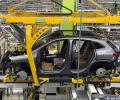
Automobile manufacturers are increasingly vocal about the mounting paperwork and delays associated with India's Production-Linked Incentive (PLI) scheme for the automotive sector, arguing that compliance requirements are becoming as challenging as meeting technical eligibility conditions. They are pushing for a simpler, faster, and more predictable certification and compliance framework.

India Inc's first-quarter earnings season was significantly impacted by the West Asia conflict, leading to rising costs, calibrated price increases, and margin pressures across various sectors including FMCG, automotive, steel, and cement. Companies are implementing price hikes to protect profitability, with many anticipating further escalations if input costs remain elevated.

The 2026 Tata Tiago EV has faster charging, is more spacious, has more features and a lifetime battery warranty. So how is st still so affordable, wonders Rajesh Alva.

The company took five years to sell the 250,000 units of the Nano.

Tata Motors is India's largest automobile company, with consolidated revenues of Rs 1,65,654 crore (Rs 1.65 trillion)

Many say Tata Motors has perhaps paid the price for being too ambitious.

The Argentinian becomes the first brand ambassador of the company in its 70-year history.
A pickup in freight rates, rising fleet utilisation and a long-awaited replacement cycle are breathing fresh life into India's commercial vehicle (CV) market, strengthening the investment case for Tata Motors' CV arm (TMCV). Despite a broadly steady December quarter (Q3) performance, brokerages remain divided on whether the upswing is strong enough to offset margin pressures.

Though the workers have not gone on strike, they moved the labour department for not receiving any wage hike since 2015.

India's leading passenger vehicle manufacturers are significantly increasing investments and factory capacities, alongside planning major product launches for FY27, driven by strong confidence in sustained domestic demand growth despite global geopolitical tensions and supply chain risks.
Tata Motors posted robust results for the June quarter, defying market forecasts and registering a 58 per cent rise in net profit for the period.

Tata Motors' UK-based subsidiary, Jaguar Land Rover or JLR, reported a muted operational performance in the December quarter of financial year 2021-22 (Q3FY22). The luxury carmaker saw a 33 per cent year-on-year (YoY) decline in wholesale volumes to just under 70,000 units in Q3, against estimates that were 16 per cent higher. The drop in despatches to dealers was on account of shortage in semiconductors.

Though strikingly similar to the Tiago, the Tata Tigor takes the design quotient a notch higher, says P Tharyan.

The Mumbai headquartered company also overtook Japanese carmaker Honda to occupy the fourth spot in domestic passenger vehicle market.
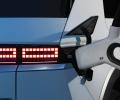
Under FAME-II, automakers provided subsidies to electric vehicle (EV) customers at the time of purchase, with the understanding that the government would reimburse the firms later.

After witnessing a historic launch, the Nano could prove to be a flagship brand for Tata Motors' fortunes.

It is keen on electric cars as battery costs go down
A company spokesperson said VRS is and will be offered to 'white-collar workers only'. Tata Motors employs around 30,000 people.

With the 40kWh battery and 65kW faster charging, it is now a legitimate primary car for a small family that can handle weekend trips easily, says Rajesh Karkera.

Usually, in the western view, corporate success is attributed to efficiency, organisational structure, and scale. R Gopalakrishnan and Harish Bhat argue that philosophy, culture, and the transmission of values are more important for sustaining growth and profitability of an enterprise over a period of time.

You know the Tata Sierra is a true icon when driving on the highways and hill climbs of Chandigarh, the car instantly drew all eyes to it.
Tata Motors' commercial-vehicle (CV) business reported a 48 per cent year-on-year decline in net profit to Rs 705 crore in Q3FY26, even as profit before tax (PBT) rose 65 per cent to Rs 2,568 crore.

In 2025, the Maruti Suzuki Dzire has emerged as India's top-selling car, while sport utility vehicles continue to rule the broader passenger vehicle market, capturing almost 55 per cent of the segment.

The new City hybrid might seem expensive at Rs 21 lakh but offers a hybrid powertrain with excellent efficiency plus more aggressive styling.

West Asia conflict triggers sharp sell-off in Indian markets, with realty, banking and auto stocks leading losses amid energy shock fears.

'Today, we are at a stage where we have launched a voice-to-voice model that supports 14 Indian languages.'

India's first trillion-dollar company will be built on technology it owns, not just operates, predicts Ajay Kumar.

Indian car buyers care more about affordability than technology, keeping ICE vehicles dominant while hybrids emerge as the preferred transition option and EVs struggle in the mass market.

Government schemes such as the PM E-Drive initiative, with allocations of around Rs 2,000 crore for charging points deployment, are helping accelerate rollout

Indian automakers are reviving legacy nameplates to leverage brand recall and stand out in a crowded market, as classic badges like Sierra, Safari, Baleno and Scorpio return to attract buyers.

Given the better growth in JLR sales and improving domestic sales, nearly 90 per cent of the analysts covering the stock have a 'Buy' rating.

'The customer is fast changing, and she demands newer experiences that wealth can buy.'
